

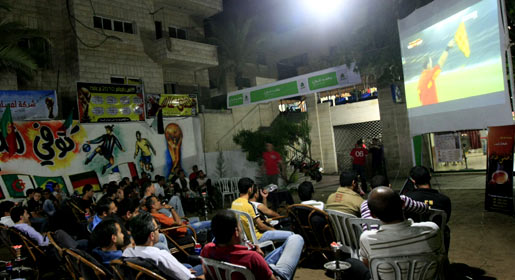
Plaestinian men smoke nargileh or waterpipes while watching a World Cup 2010 match on a big screen at an outdoors cafe in Gaza City. Football fans escape the Gaza Strip's dreary confinement to follow the WC2010 matches which are often interrupted by power cuts. —AFP Photo
GAZA CITY: There was standing room only at the seaside cafe as World Cup fans escaped the Gaza Strip’s dreary confinement for a 90-minute match only briefly interrupted by power cuts.
Palestinians have always been avid football fans, but this year’s tournament is drawing record crowds to flag-decked cafes with humming generators across impoverished Gaza, where there are few other ways to pass the time.
“All the people of Gaza have are the sea and the World Cup,” says Abu Mohammed al-Sultan, 44, who set up a projection screen at the beach cafe. “I figured I would combine the two and double my customers.”
Israel and Egypt have sealed Gaza off from all but basic goods and severely limited travel since the June 2006 capture of an Israeli soldier.
The sanctions were tightened when Hamas seized power a year later, and Israel has said the closures and its naval blockade are needed to keep the Islamist movement from importing weapons.
Since Israel’s deadly seizure last month of an activist aid flotilla, both countries have eased the closures, with Egypt allowing some students and patients to leave and Israel expanding its list of permitted imports.
But the enclave of 1.5 million residents, 80 percent of whom rely on foreign aid, remains largely cut off from the world, and the World Cup provides a rare release from the grim boredom of day-to-day life.
Gazans organised their own mock World Cup last month in anticipation of the real thing, with 16 local teams posing as national squads and “France” routing “Jordan” to win the championship.
“We are locked up in this little prison. So we are all looking for new interests, and the World Cup is a good way to enjoy ourselves,” said Hisham, 30, as he watched Friday’s 0-0 draw between England and Algeria.
The match, featuring the only Arab team to have qualified for the tournament, drew an especially large crowd, including many women who previously had little interest in sports.
“I never watched football before, but this year I am really enjoying it,”says Rawan, a young woman who came with her university classmates.
“There is really nothing else in Gaza, and I cannot travel with my family like in previous years because of the siege. We’ll be spending the whole summer break here,” she says.
As the second half began with both teams still scoreless the power went out for several minutes, drawing howls from the spectators until waiters managed to hook up a backup generator.
Gaza’s electricity goes out for an average of eight hours a day, both because of the blockade and a running feud between Hamas and its rivals in the West Bank-based Palestinian Authority over the purchase of fuel for Gaza’s sole power plant, partially destroyed by Israeli air strikes in 2006.
“We don’t have the pay-per-view channels at home, and even if we did the electricity is out most of the day,” says Mahmud Badran, 35, as he reclines with a softly gurgling water pipe.
“My wife and kids come here almost every day to play in the sea because there’s nothing else to do, and I get to sit here with my friends and watch football,” he says.
“I always watched the important matches in the past, but now I watch all of them with great interest.”
As the match came to an end, the crowd broke into applause and dancing, the young men chanting “Victory for the Green, England’s going, bye-bye,” in reference to Algeria’s green jerseys.
The same celebratory atmosphere prevailed at another nearby cafe, where Anas, 23, was delighted to see England held.
“I am against any country allied with Israel, like America and Denmark and England,” he said. “I hope Argentina wins the Cup this year.”
The closures, by limiting the import of building materials to UN-sponsored projects, have severely hindered reconstruction efforts following a devastating 22-day Israeli offensive launched in December 2008 to halt rocket attacks.
And although the closures were in part aimed at undermining support for Hamas, most Gazans blame Israel for their predicament, and the blockade has done nothing to loosen the Islamist movement’s grip over the coastal enclave.
The enduring political stalemate has meant that for young Palestinians like 11-year-old Amr Khadr, the world outside Gaza is visible only through an flickering TV screen.
“I see a lot of children on television in the stands,” he says. “I wish I could be one of them.” —AFP




